 MarketMoodz
Space-Based AI Data Centers: Economics or Science Fiction?
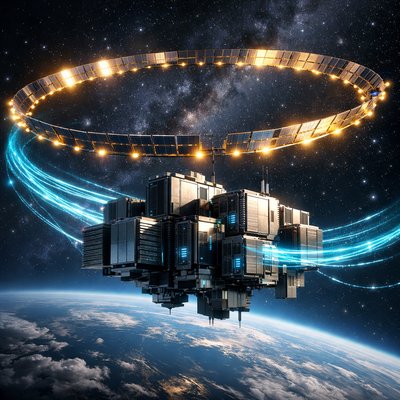
CNBC lays out a provocative case: put AI data centers in orbit to bypass land, water and electricity constraints by tapping near‑constant solar power and satellite connectivity. Proponents point to falling launch costs and orbital solar as a route to scalable compute; critics say the economics remain speculative and hinge on major technological, regulatory and cost breakthroughs.
Key Takeaways
- CNBC argues orbital data centers could sidestep terrestrial land, water and electricity limits by using near‑constant solar power in orbit.
- Google projects launch costs could fall below $200/kg by the mid‑2030s, a threshold that would materially improve the orbital cost case.
- CNBC reports a 2026 SpaceX IPO that raised $85.7 billion and valued the company in the trillions, but that claim lacks independent verification.
- Near‑term pilots reportedly include sending GPUs and data‑center components to space (for example, tests using Nvidia H100-class hardware) to validate thermal and radiation resilience.
- Industry skeptics say the economic case is marginal today; long‑term viability depends on persistent terrestrial cost increases, much lower launch costs, regulatory approvals and proven on‑orbit operations.
People Involved
- Elon MuskSpaceX CEO; proponent of orbital compute and Starlink connectivity
- Duncan DavidsonPartner, Bullpen Capital (quoted/mentioned in coverage)
- Jeff BezosFounder, Blue Origin (participant in space‑infrastructure discussions)
Entities Involved
- SpaceX (private)Promotes Starlink connectivity and has been linked to orbital data‑center concepts
- xAIAI company tied to higher compute demand and associated with SpaceX ecosystem
- Starlink (SpaceX)Satellite broadband network proposed as orbital data‑center connectivity backbone
- Alphabet/Google (GOOGL)Cited for projections on launch costs and reported interest in space solar concepts
- Planet LabsMentioned in reporting on collaboration with Google on orbital solar concepts
- Blue OriginJeff Bezos's space company, referenced as an active participant in the space‑AI discussion
- AnthropicNamed as a potential commercial customer/partner in coverage, though unverified
- Terafab (Austin project)Reported large terrestrial AI fabrication project mentioned in coverage; project details lack independent confirmation
- Rocket Lab (RKLB)Small‑sat and launch provider mentioned in sector context
- Intel (INTC)Named as a partner in large terrestrial facilities reporting
- NVIDIA (NVDA)GPU maker; H100‑class hardware cited in reported in‑orbit testing pilots
MarketMoodz Analysis
For investors, the headline calculus is simple: if launch costs and in‑orbit energy advantages fall far enough, capital spending on terrestrial hyperscale farms could be rerouted to orbital infrastructure — changing the addressable market for cloud providers, launch firms and satellite servicers. That outcome requires launch costs to decline dramatically (Google’s cited sub‑$200/kg benchmark for the mid‑2030s is one such pivot point) and for operators to solve hard engineering problems — radiation‑tolerant components, thermal management, in‑space maintenance and secure, high‑throughput downlinks. Near‑term pilots that send GPUs and other components to orbit will matter more to markets than PR: investors should look for demonstrable metrics (reliable throughput, energy cost per compute unit, failure rates) rather than proclamations about future fleets.
History offers both precedent and caution. The cloud era bloomed when economics and software aligned; reusable rockets cut launch prices and opened new business models, but past hype about ‘what space could do’ has repeatedly outpaced economics. Several claims in current coverage — a blockbuster SpaceX IPO valuation, a $119 billion Terafab build cost, filings for a million‑satellite constellation — lack independent verification and should be treated as speculative. Watch the plumbing: credible FCC filings, contractual commitments from hyperscalers or enterprise customers, third‑party cost models showing parity with terrestrial power+land costs, and successful long‑duration hardware tests in orbit; those milestones will move this idea from speculative to investable over years, not quarters.
Source: Original Article